Why a $20 billion automaker still cannot own Nissan.com after 32 years
In December 1999, Nissan Motor Co. sued a North Carolina computer repairman for $10,000,000 to seize Nissan.com. His legal birth name was Uzi Nissan. He spent over $3,000,000 across eight years of federal court battles, defeated the dilution claim at the Ninth Circuit, and kept his family name.
 Tat Thang
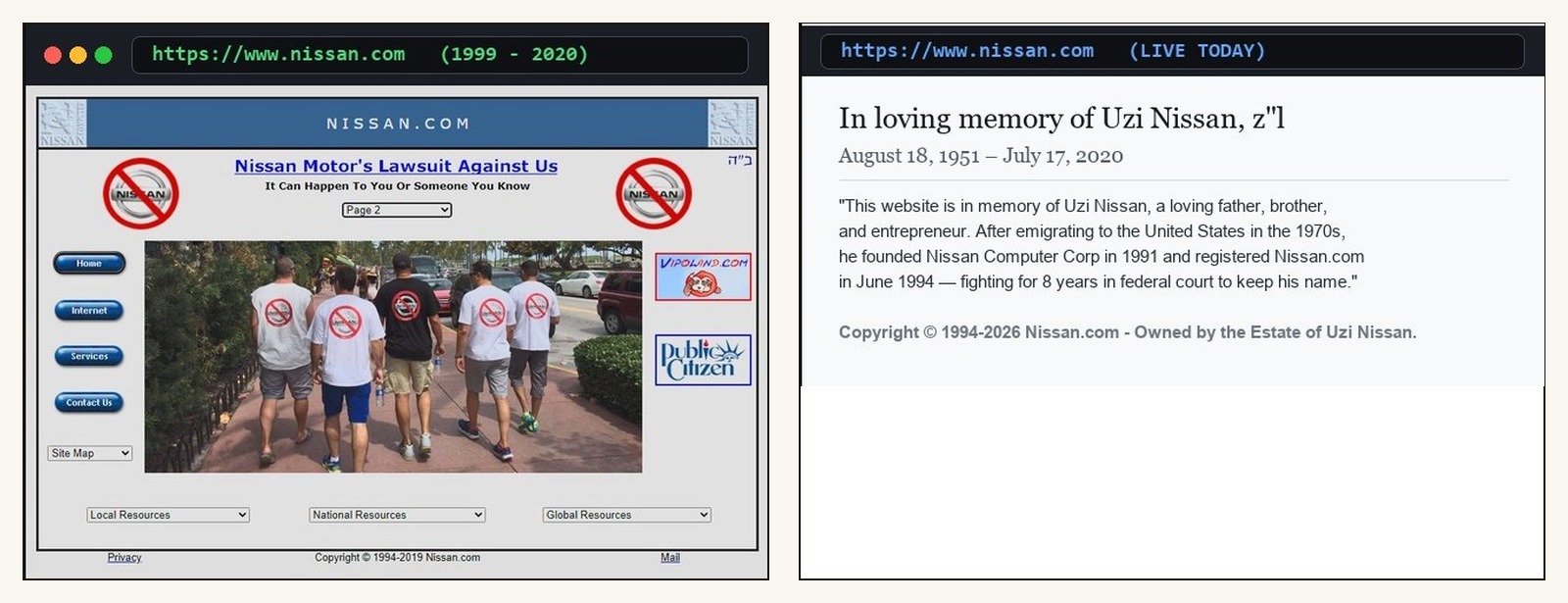
Type nissan.com into any web browser today and you will not find a configurator for an Altima, a dealer locator, or a corporate landing page for Japan’s multinational automaker. Instead, you land on a stark white memorial page for a small-business computer technician from Raleigh, North Carolina, accompanied by a 1990s web archive carrying two red stop signs that read NO!
To buy a car from Nissan Motor Co., Ltd. in the United States, a customer still has to type nissanusa.com. Thirty-two years after the commercial web took shape, a manufacturer generating tens of billions of dollars in annual revenue still does not own the exact-match dot-com for its brand.
The reason is not a lapsed renewal or a cybersquatting holdout. On December 10, 1999, Nissan Motor Co. sued a North Carolina entrepreneur for $10,000,000 in federal court to take nissan.com and nissan.net by force. The defendant’s legal birth name was Uzi Nissan. Rather than sign away his surname, he mortgaged his home, spent more than $3,000,000 across eight years of federal litigation, and broke the legal attrition formula that global corporations use to erase small operators.
FIG. 01 · THE $10M ATTRITION MATH
Nissan Motor demanded $10.0M for Nissan.com; Uzi Nissan spent over $3.0M defending his surname and paid $0 in damages.
Headline damages demanded by Nissan Motor Co. on Dec 10, 1999 against Uzi Nissan's 8-year legal defense spend (USD) · Total $10.0M
Uzi Nissan 8-year defense spend$3.0M
- Out-of-pocket federal trial and 9th Circuit appeal fees$3.0MNissan Computer Corp. Lawsuit Digest (nissan.com)
Uncollected of $10M demand ($0 won)$7.0M
- Remaining claim rejected in court ($0 damages awarded)$7.0Mderived
- Nissan Motor recovered $0 in damages, failed to seize Nissan.com, and was ordered to pay $58,000 in court costs. Nissan Computer Corp. Lawsuit Digest (nissan.com)
Sources: Nissan Motor Co. v. Nissan Computer Corp., 378 F.3d 1002, Nissan Computer Corp. Lawsuit Digest (nissan.com). Complaint filed Dec 10, 1999 in U.S. District Court (C.D. Cal., Case No. CV 99-12980 DDP) seeking $10M and transfer of nissan.com and nissan.net. Final resolution after Ninth Circuit remand (378 F.3d 1002).
The chronology that corporate lawyers tried to rewrite
Most trademark disputes look one-sided because the public assumes the multinational brand arrived first. The federal docket in Nissan Motor Co. v. Nissan Computer Corp. (378 F.3d 1002, 9th Cir. 2004) tells the opposite chronology.
Uzi Nissan was born in Jerusalem on August 18, 1951, where his father, Nissim Nissan, gave him the family surname that also names the seventh month of the Hebrew calendar. After serving in the Israeli Air Force and immigrating to the United States in 1976, Uzi settled in Raleigh, North Carolina. At the time he arrived in America, Japan’s Nissan Motor Co. marketed its vehicles in the United States under the Datsun badge, only beginning to phase in the Nissan brand across American dealerships between 1981 and 1984.
Uzi built every business he owned under his legal surname:
- 1980: Founded Nissan Foreign Car in Raleigh, North Carolina, servicing imported automobiles.
- 1987: Launched Nissan International, Ltd., an export-import firm selling heavy equipment and diagnostic computers.
- May 14, 1991: Incorporated Nissan Computer Corp. in North Carolina to sell personal computers, servers, and repair services.
- June 4, 1994: Registered the domain name nissan.com with Network Solutions to serve Nissan Computer Corp. customers, followed by nissan.net as an internet service provider in March 1996.
For five full years after June 1994, Nissan Motor Co. watched nissan.com operate openly without filing a legal challenge. Then, in 1999, after Uzi upgraded his site and began running third-party banner advertisements routed through GoTo.com, the automaker sent a letter demanding control of the domain. When Uzi declined to hand over the address of his eight-year-old computer firm without compensation for rebranding his business, Nissan Motor skipped negotiation and filed a $10,000,000 federal complaint in the Central District of California, 2,500 miles away from Uzi’s home in North Carolina.
How corporate attrition math works, and where it broke
In high-stakes commercial litigation, a $10,000,000 prayer for relief against a five-person computer shop is not designed to be collected after a jury verdict. It is designed to make the defendant’s accountant force a surrender in week two.
Litigating a federal trademark and Federal Trademark Dilution Act (FTDA) case across the country requires depositions, consumer confusion surveys, expert witnesses, and years of summary judgment briefing. Even when a small business is 100% right on the law, spending $400,000 a year on legal fees to protect a server rack in Raleigh is irrational on a standard balance sheet.
At first, the attrition machine worked almost exactly as Detroit and Tokyo counsel expected. In 2002, the district court in Los Angeles granted partial summary judgment to Nissan Motor on trademark dilution and restricted Uzi from placing commercial content or links to critical commentary about the lawsuit on nissan.com. Most defendants fold the day an injunction cuts off their business revenue while legal bills pass the second million.
Uzi Nissan did not fold. He replaced every commercial link on nissan.com with a noncommercial protest chronicle titled “Nissan Motor’s Lawsuit Against Us: It Can Happen To You Or Someone You Know,” appealed to the U.S. Court of Appeals for the Ninth Circuit, and forced a three-judge panel led by Circuit Judge Alex Kozinski to examine the exact dates of the statute.
“The First Amendment prohibits imposing liability for speech that is not commercial, even if it is disparaging. Injunctions under the FTDA may not enjoin links to sites that disparage or criticize the mark holder.”
On August 6, 2004, Judge Kozinski’s opinion in 378 F.3d 1002 dismantled the core of Nissan Motor’s seizure strategy on three structural grounds:
- The first commercial use clock: Under the Federal Trademark Dilution Act of 1996, a mark holder can only claim dilution if its mark was already famous before the defendant’s first commercial use of the name in commerce. Because Uzi incorporated Nissan Computer Corp. and used the name commercially in May 1991, the Ninth Circuit held that Nissan Motor had to prove trademark fame as of 1991, not 1994 when the domain was registered, reversing summary judgment and sending the fame question back to the trial court.
- Non-automobile trademark boundaries: While the court affirmed that Uzi could not run auto-related ad links that traded on car buyers’ searches, it ruled that he retained the right to use his family name and nissan.com for non-automotive business and commentary.
- First Amendment immunity for critical speech: The Ninth Circuit struck down the district court’s injunction barring Uzi from linking to websites criticizing Nissan Motor, holding that the FTDA cannot be used as a gag order against noncommercial speech even when that speech disparages a corporate plaintiff.
When the case finally concluded in 2007 after eight years of litigation, Nissan Motor Co. walked away with $0 in damages, failed to win transfer of nissan.com or nissan.net, and was ordered to pay $58,000 toward court costs.
The four-case rule: when Goliath’s spreadsheet loses
Uzi Nissan is not an isolated anomaly. Across sixty years of North American commercial law, whenever a multi-billion-dollar corporation tries to use litigation attrition to seize a name, territory, or invention from a single operator, the outcome follows a strict structural split.
FIG. 02 · FOUR ASYMMETRIC MOATS
When a solo operator holds prior legal title to a birth name, trademark, or patent, corporate attrition math breaks.
Primary court records across four David-vs-Goliath business battles in U.S. and Canadian history
| Dispute | Demand or offer | Legal anchor | Final outcome |
|---|---|---|---|
| Uzi Nissan vs. Nissan Motor | $10M sued; >$3M defenseNissan Computer Corp. Lawsuit Digest (nissan.com) | 378 F.3d 1002 (9th Cir.)Nissan Motor Co. v. Nissan Computer Corp., 378 F.3d 1002 | Kept Nissan.com & .net ($0 won)Nissan Motor Co. v. Nissan Computer Corp., 378 F.3d 1002 |
| Robert Kearns vs. Ford & Chrysler | Rejected $30M Ford offerKearns v. Chrysler Corp., 32 F.3d 1541 (Fed. Cir. 1994) | US Patent 3,351,836 (1967)Kearns v. Chrysler Corp., 32 F.3d 1541 (Fed. Cir. 1994) | $10.2M Ford + $18.7M ChryslerKearns v. Chrysler Corp., 32 F.3d 1541 (Fed. Cir. 1994) |
| Hoots family vs. Burger King | Rejected $10K buyoutBurger King of Florida, Inc. v. Hoots, 403 F.2d 904 | 403 F.2d 904 (7th Cir.)Burger King of Florida, Inc. v. Hoots, 403 F.2d 904 | 20-mile Mattoon exclusion zoneBurger King of Florida, Inc. v. Hoots, 403 F.2d 904 |
| Mike Rowe vs. Microsoft | $10 offer + 25-page WIPO threatCNET Archive: Microsoft settles with MikeRoweSoft (2004) | Birth-name phonetic use (2003)CNET Archive: Microsoft settles with MikeRoweSoft (2004) | Paid settlement + $1,037 eBayCNET Archive: Microsoft settles with MikeRoweSoft (2004) |
Sources: Nissan Motor Co. v. Nissan Computer Corp., 378 F.3d 1002, Nissan Computer Corp. Lawsuit Digest (nissan.com), Kearns v. Chrysler Corp., 32 F.3d 1541 (Fed. Cir. 1994), Burger King of Florida, Inc. v. Hoots, 403 F.2d 904, CNET Archive: Microsoft settles with MikeRoweSoft (2004). All four cases turned on documented prior rights or birth-name identity: Uzi Nissan (1994 domain, 1991 corporation), Robert Kearns (1967 wiper patent), Gene and Betty Hoots (1959 Illinois mark), and Mike Rowe (2003 surname pun).
Look at the four cases side by side in the docket record:
- Uzi Nissan vs. Nissan Motor (1999 to 2007): Birth surname + 1991 corporate charter + 1994 domain registration beat a $10,000,000 dilution lawsuit.
- Robert Kearns vs. Ford & Chrysler (1978 to 1995): An engineering professor blinded in one eye on his wedding night built the intermittent windshield wiper in his Detroit basement (US Patent 3,351,836, granted November 1967). After Ford copied his timing circuit onto millions of cars and paid him $0, Kearns fired his lawyers, rejected a $30,000,000 out-of-court settlement because Ford refused to admit in writing that he was the inventor, and won $10.2 million from Ford and $18.74 million from Chrysler at trial.
- Gene & Betty Hoots vs. Burger King (1968): A family in Mattoon, Illinois converted a two-car garage behind their Frigid Queen ice cream stand into a burger shop called Burger King in 1957 and registered an Illinois state trademark in July 1959, two years before corporate Burger King obtained its federal Lanham Act mark in October 1961. In 403 F.2d 904 (7th Cir. 1968), the court carved out a permanent 20-mile exclusion zone around 1508 Charleston Avenue in Mattoon where none of Burger King’s 19,700 global stores can open to this day.
- Mike Rowe vs. Microsoft (2003 to 2004): A 17-year-old Canadian high school student registered MikeRoweSoft.com for $10 as a phonetic pun on his legal birth name. When Microsoft’s lawyers offered him $10 and then FedExed a 25-page WIPO legal threat, Rowe published the letters online, drew 250,000 page views in 12 hours, forced Microsoft to settle publicly, donated his legal defense fund to a children’s hospice, and auctioned Microsoft’s cease-and-desist book on eBay for $1,037.
What operators should take from nissan.com
Uzi Nissan passed away from COVID-19 on July 20, 2020 at age 69. Yet six years after his death and thirty-two years after he paid his first registration fee, his estate still holds the cryptographic and legal keys to nissan.com.
Corporate legal departments run on expected-value spreadsheets. Those spreadsheets assume every human being has a walk-away price lower than the cost of discovery. When you anchor your business in dated, prior-in-time legal title, whether a state trademark, a patent filing, or a domain registered in good faith before a counterparty claims exclusivity, you hold property that money alone cannot condemn. And when an opponent mistakes a principle for a price tag, the $10,000,000 threat becomes a permanent monument to the company that lost.
Sources & image credits (7)
What would prove this wrong
This thesis is falsified if the Estate of Uzi Nissan transfers or sells the nissan.com or nissan.net domain registrations to Nissan Motor Co., Ltd., or if a subsequent federal ruling overturns the Ninth Circuit's 2004 precedent in Nissan Motor Co. v. Nissan Computer Corp. (378 F.3d 1002) regarding pre-1996 fame and noncommercial critical speech.
Sources
- [1] Nissan Motor Co. v. Nissan Computer Corp., 378 F.3d 1002 (9th Cir. Aug. 6, 2004) ↗
- [2] Nissan Computer Corp. Official Domain & Case Archive (nissan.com) ↗
- [3] Tat Thang (@tatthang): Uzi Nissan vs. Nissan Motor dossier (5.52M views on X) ↗
- [4] Kearns v. Chrysler Corp., 32 F.3d 1541 (Fed. Cir. 1994) ↗
- [5] Burger King of Florida, Inc. v. Hoots, 403 F.2d 904 (7th Cir. 1968) ↗
- [6] CNET Archive: Microsoft settles with MikeRoweSoft (Jan 2004) ↗
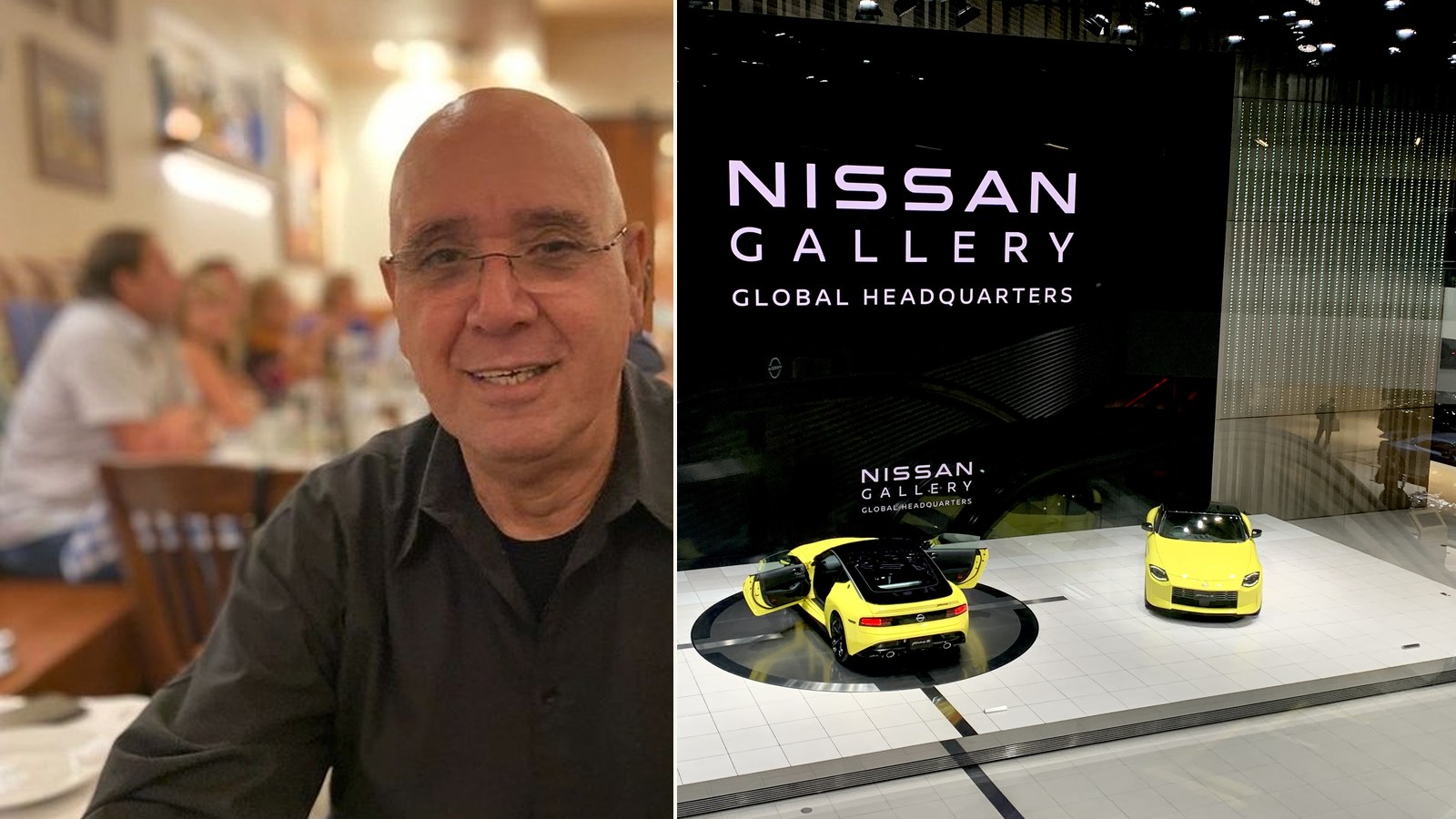
Images: Estate of Uzi Nissan / Kazyakuruma, CC BY-SA 4.0, split composite, metadata removed
The Uncut Notebook on Substack
The Weekly Edition, plus what stays off this site: operator playbooks, uncut onchain wallet dossiers, and notes from the system behind this notebook. No spam, no paywall.
Subscribe on Substack ↗