Why NFT floors stay down 90% even after Walmart and Prime Video
Pudgy Penguins sells toys across 3,100 Walmart and 1,800 Target stores. Chimpers signed a six-year global licensing deal. Claynosaurz streams to 90 million TV homes. Why real-world consumer wins do not lift secondary NFT prices.
 Tat Thang
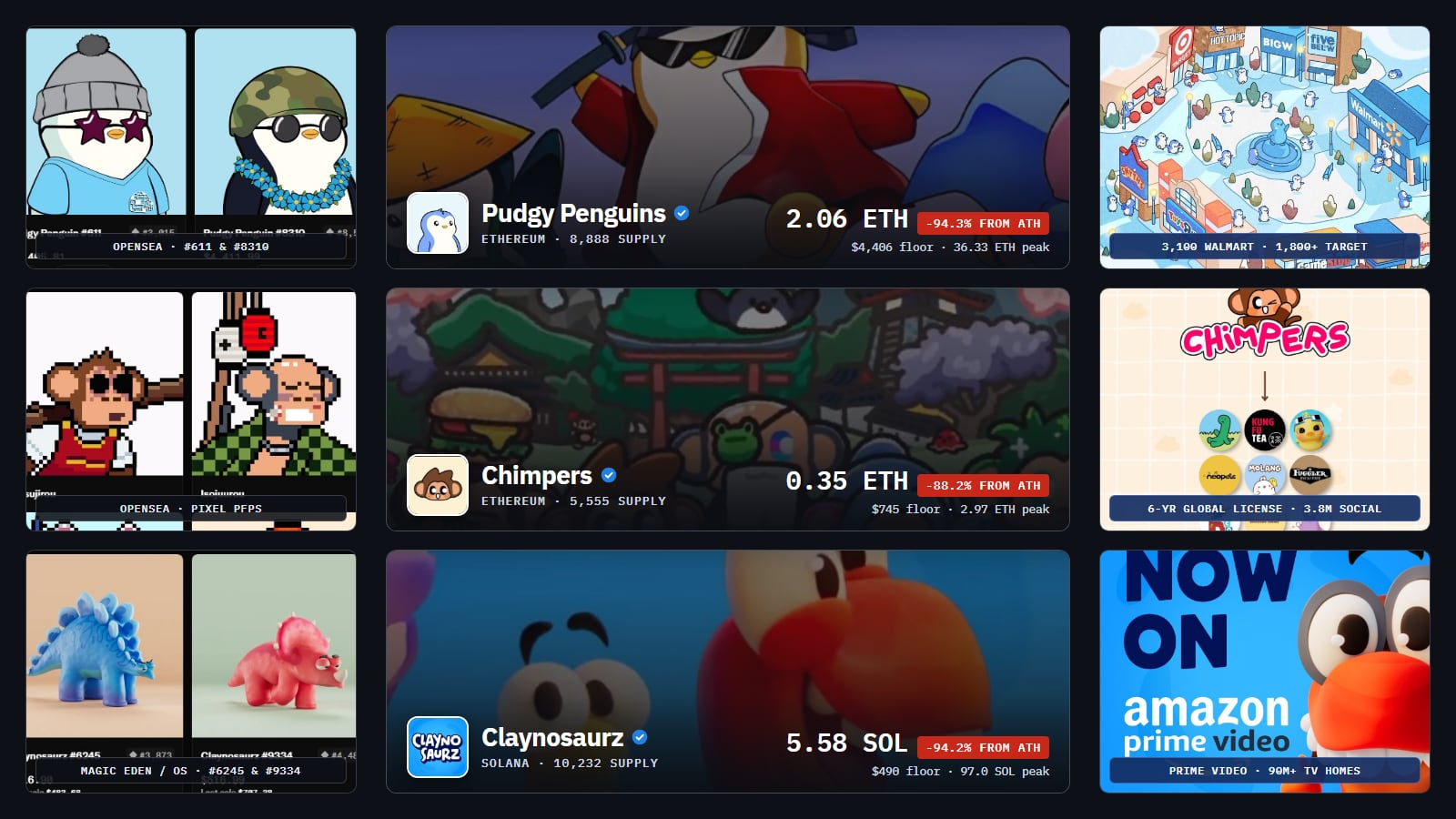
Walk down the toy aisle of one of 3,100 Walmart supercenters or 1,800 Target stores in the United States today and you can pick up a Pudgy Penguins plush toy for roughly $12. Since entering mass retail in February 2024, shoppers have bought well over one million physical Pudgy toys across Walmart, Target, Walgreens, Five Below, Barnes & Noble, GameStop, and Hot Topic, while the brand’s character clips have crossed 120 billion views on GIPHY. By traditional consumer-brand standards, Pudgy Penguins achieved the exact breakout Web3 founders promised during the 2021 bull market: real products, real shelves, and mainstream buyers who know nothing about crypto.
Open OpenSea on November 9, 2026, however, and the original 8,888-piece Pudgy Penguins NFT collection tells the opposite story. The lowest-priced penguin sits near 2.06 to 2.07 ETH ($4,406), down 94.3% in ETH from its 36.33 ETH ($145,728) peak in December 2024. Across all 8,888 tokens, total collection value has compressed from roughly $1.30 billion at peak to $39.3 million.
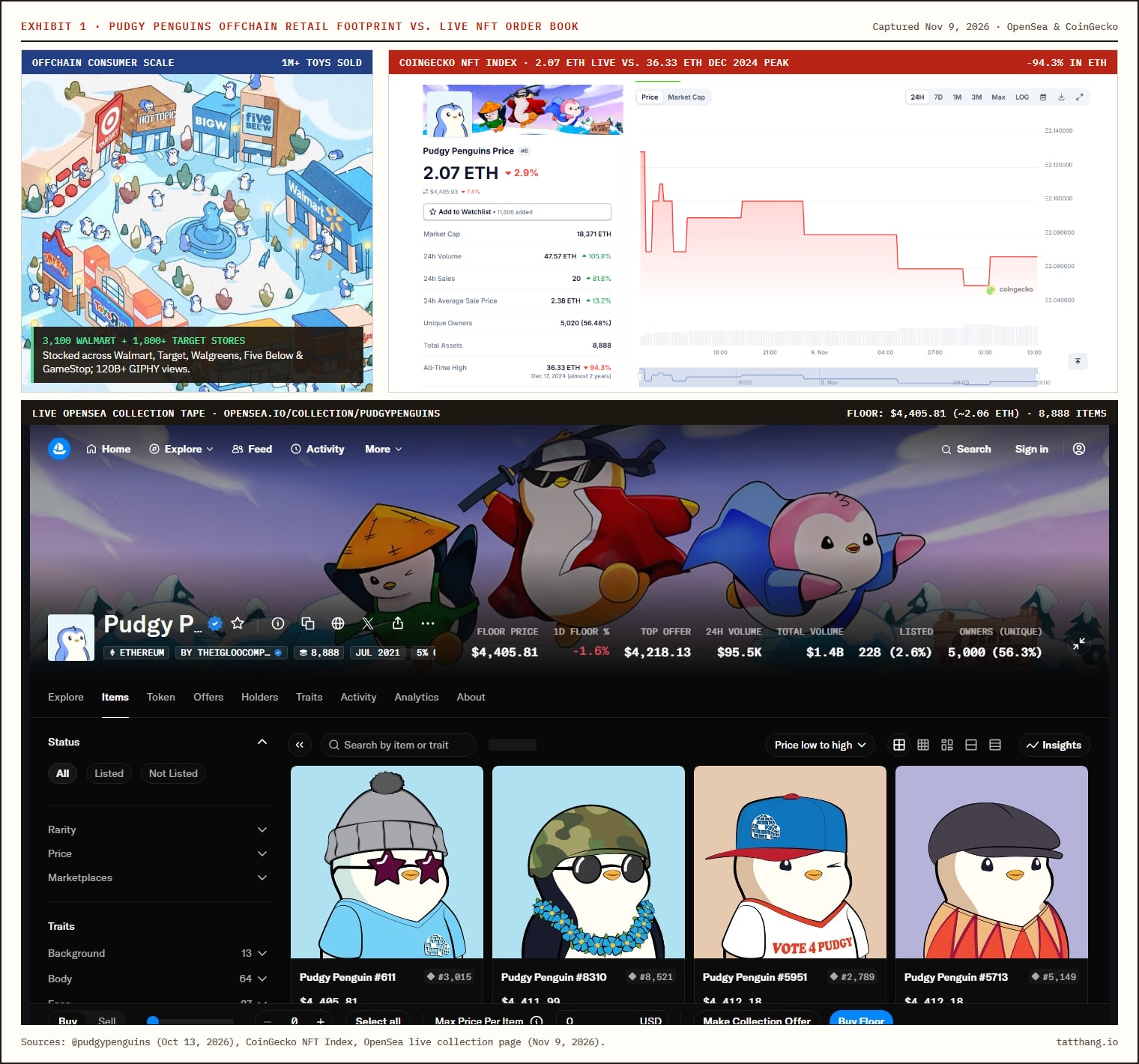
A $12 plush toy at Target and a $4,400 JPEG on OpenSea do not share a cash register
To understand why selling a million stuffed penguins does not push an NFT higher, follow what happens at the checkout counter.
First, the customer is completely different. A parent buying a $12 plush toy for a child at Target pays with a debit or credit card at checkout. Almost none of those shoppers go home, set up a self-custody Ethereum wallet, and spend $4,400 on a digital profile picture.
Second, retail revenue flows to the operating company, not to the NFT order book. Out of a $12 shelf price, Walmart or Target keeps its retail margin, the manufacturer covers materials and freight, and the wholesale profit or licensing royalty lands in the corporate bank account of Igloo Inc., the private company behind Pudgy Penguins. Zero cents of that checkout receipt automatically go onto OpenSea to buy listed NFTs off the market.
What store sales actually pay for is non-dilutive corporate survival. During a multi-year slump in NFT trading fees, studios without real-world income either run out of money or mint endless new collections to cover payroll. Toy purchase orders pay animators, licensing managers, and supply-chain staff in dollars so the brand can keep compounding through 2030 without draining crypto holders.
Secondary floors price 30-day token coupons, not 10-year store rollouts
If toy sales did not price the NFT, what did? The calendar leaves zero room for guesswork.
Pudgy Penguins did not reach its 36.33 ETH ($145,728) all-time high in February 2024 when Walmart first stocked the toys, or in May 2024 when physical sales crossed one million units. It peaked on December 17, 2024, the exact week NFT holders were claiming the new PENGU cryptocurrency airdrop.
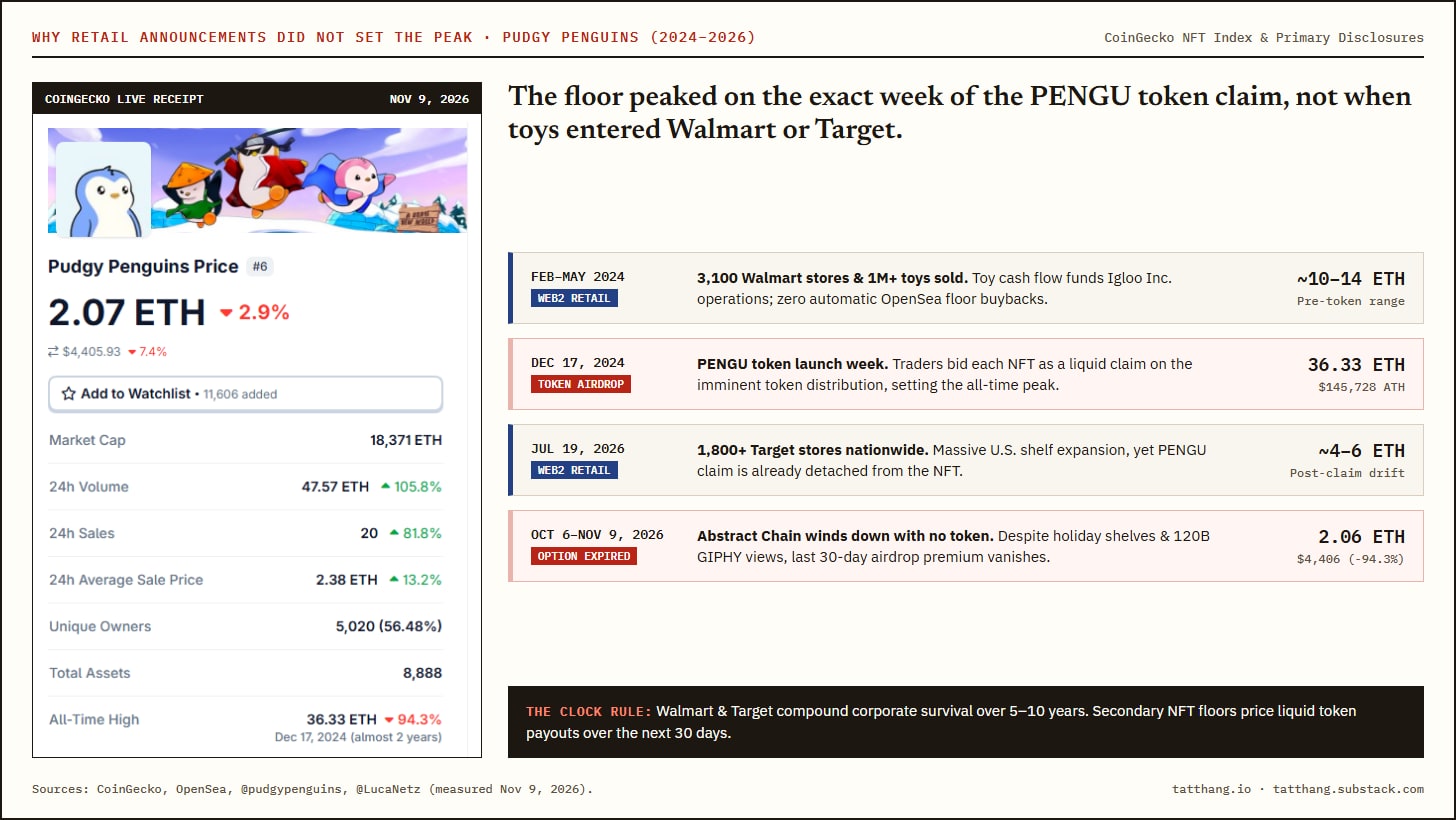
Traders were pricing each NFT like a coupon attached to an immediate cash payout. Once the PENGU token distributed and began trading on its own liquid exchanges (where it now carries a $391.7 million market cap near $0.00623), that coupon detached from the NFT.
For the next 21 months, much of the remaining speculative premium in a Pudgy Penguins NFT rested on expectations of a second major token launch from Igloo Inc.’s consumer blockchain project, Abstract. On October 6, 2026, chief executive Luca Netz announced that Igloo was shutting Abstract down after losing tens of millions of dollars over two years, and explicitly ruled out launching an Abstract token just to recoup those losses.
“Even after losing 8 figures, we could have launched a token or pursued an ICO. Ultimately we decided against this.”
Declining to launch a token without product-market fit was a disciplined corporate decision. Inside the NFT market, however, it removed the last near-term payout traders were waiting to collect. Even as Pudgy Penguins stocked holiday shelves across Target and Walmart in October, the NFT floor drifted down toward 2 ETH.
Even zero VC debt, open-market buybacks, and 15% holder equity cannot override a 24-hour order book
A skeptic might argue that Pudgy Penguins simply peaked too high around its token launch, or that an NFT floor would hold if a studio raised zero venture capital, bought its own ecosystem token on the open market, or gave NFT holders real equity in the brand.
Two other leading Web3 character studios tested every one of those conditions in 2026. Both show the exact same price curve.
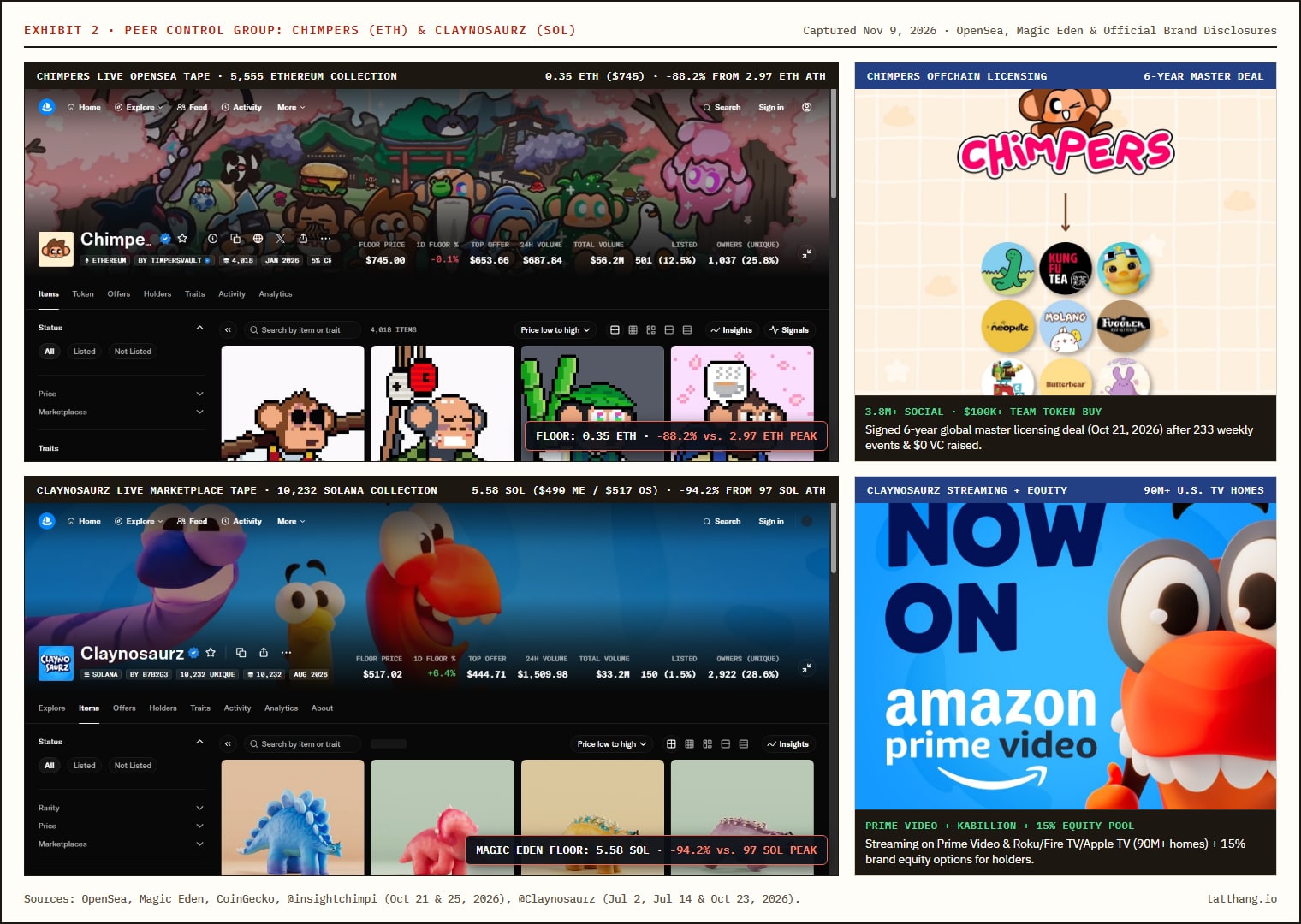
Chimpers, a 5,555-piece Ethereum collection co-founded by pixel artist Timpers and Jacob Timperley (@insightchimpi) with zero venture capital, built an audience of more than 3.8 million followers across TikTok, Instagram, and Facebook and passed one billion views on GIPHY. On October 21, 2026, Timperley disclosed a six-year global master licensing agreement to bring Chimpers into physical retail worldwide, backed by 233 consecutive weekly community events. Onchain, after a zero-team-allocation launch of CHMPSTR, the founders spent more than $100,000 of their own capital buying over 72 million tokens on the open market for treasury and collector rewards. On November 9, Chimpers still traded at 0.35 ETH ($745 to $751), down 88.2% from its 2.97 ETH peak.
“Real world collaborations, partnerships, and most significantly, a 6 year global master licensing agreement to bring Chimpers into retail, products and experiences worldwide. None of this happens overnight.”
Claynosaurz ran the most direct test of all. A common complaint among NFT collectors is that digital tokens fall because holders own zero legal stake in the real-world entertainment company. Claynosaurz closed that gap head-on. Alongside launching on Amazon Prime Video in July 2026 and expanding across Roku, Amazon Fire TV, and Apple TV in October via Kabillion, a free kids network reaching more than 90 million U.S. TV households, the 10,232-piece Solana studio announced on July 2, 2026 that it had reserved a 15% allocation of brand equity options for eligible ecosystem holders.
Four months after setting aside 15% brand equity options and landing in 90 million American television homes, Claynosaurz traded at 5.58 SOL ($490) on Magic Eden on November 9, down 94.2% from its 97 SOL peak.
FIG. 01 · THREE IP STUDIOS
Mainstream retail shelves and streaming distribution reached record scale in 2026 while all three NFT floors stayed down 88% to 94%.
Offchain consumer reach vs. native-currency NFT floor prices as of Nov 9, 2026 (03:30 UTC)
| Studio | Offchain reach | Nov 9 floor | From ATH |
|---|---|---|---|
| Pudgy Penguins (8,888 ETH) | 3,100 Walmart, 1,800+ Target@LucaNetz: 1,800+ Target debut | 2.07 ETH ($4,418)CoinGecko: Pudgy Penguins NFT | -94.3%derived |
| Chimpers (5,555 ETH) | 3.8M social, 6-yr license@insightchimpi: 6-year licensing | 0.35 ETH ($751)CoinGecko: Chimpers NFT | -88.2%derived |
| Claynosaurz (10,232 SOL) | 90M+ TV homes, 15% equity@Claynosaurz: 90M U.S. TV homes | 5.58 SOL ($490)Magic Eden: Claynosaurz stats | -94.2%derived |
Sources: @LucaNetz: 1,800+ Target debut, CoinGecko: Pudgy Penguins NFT, @insightchimpi: 6-year licensing, CoinGecko: Chimpers NFT, @Claynosaurz: 90M U.S. TV homes, Magic Eden: Claynosaurz stats. ETH spot at $2,143.62 and SOL spot at $87.71 on Nov 9, 2026. Peaks: Pudgy Penguins 36.33 ETH (Dec 2024), Chimpers 2.97 ETH (Jun 2022), Claynosaurz 97.0 SOL.
The math of one brand running on two clocks
Why could not even a 15% brand equity pool keep Claynosaurz from sitting 94% below its high? Do the math on how the two assets clear.
Options in a private entertainment studio pay off on a five-to-ten-year clock. They only convert into spendable cash if the company is acquired, goes public, or distributes profits years down the road. An NFT marketplace, by contrast, marks every holder’s position to the most impatient seller every 24 hours. Across the seven days leading into November 9, Claynosaurz recorded roughly $23,850 in total trading volume on Magic Eden, or $3,407 per day. At a $490 floor price, just seven forced sales a day absorb the entire daily bid side of a franchise streaming into 90 million television homes.
Consumer milestones and NFT floor prices are not contradicting each other. They are simply keeping time on two different clocks:
- Retail shelves and TV deals run on a five-to-ten-year survival clock. Store distribution, six-year licensing guarantees, and 90 million TV homes bring in outside revenue and build brand recognition toward 2030. They sharply reduce the risk that a studio runs out of money and disappears during a crypto winter.
- NFT floors run on a 30-day liquidity and payout clock. Secondary crypto markets price profile-picture NFTs around how much cash is actively trading onchain this month and whether a liquid token payout is weeks away. When the payout passes and volume dries up, the floor compresses back to illiquid collectible levels.
Seeing plushies in Walmart while the NFT sits down 90% does not mean the business failed, and it does not mean offchain expansion was a waste of effort. Buyers only misread the market when they purchase a 30-day crypto trading instrument expecting a 10-year toy and television business to push its price up next month.
Not financial advice.
Sources & image credits (17)
What would prove this wrong
This reading is wrong if retail shelf expansion or streaming announcements alone lift Pudgy Penguins back above 15 ETH, Chimpers above 1.5 ETH, and Claynosaurz above 40 SOL for 60 consecutive days without a new token claim, mechanical onchain buyback sink, or broad crypto liquidity surge.
Sources
- [1] @pudgypenguins: Pudgy Toys rollout across 3,100 Walmart stores (Feb 20, 2024) ↗
- [2] @LucaNetz: Over 1,000,000 physical toys sold in 12 months (May 12, 2024) ↗
- [3] @LucaNetz: Pengu retail debut in 1,800+ Target stores nationwide (Jul 19, 2026) ↗
- [4] @LucaNetz: Abstract Chain wind-down disclosure (Oct 6, 2026) ↗
- [5] @pudgypenguins: 120 billion GIPHY views milestone (Oct 11, 2026) ↗
- [6] @pudgypenguins: U.S. retail footprint across Walmart, Target, Walgreens, and GameStop (Oct 13, 2026) ↗
- [7] OpenSea: Pudgy Penguins live Ethereum collection page (Nov 9, 2026) ↗
- [8] CoinGecko: Pudgy Penguins NFT floor, supply, and ATH data (Nov 9, 2026) ↗
- [9] @insightchimpi: Chimpers 3.8M+ social audience milestone (Sep 13, 2026) ↗
- [10] @insightchimpi: Chimpers 6-year global master licensing agreement (Oct 21, 2026) ↗
- [11] @insightchimpi: Chimpers open-market CHMPSTR treasury purchases (Oct 25, 2026) ↗
- [12] CoinGecko: Chimpers NFT floor, supply, and ATH data (Nov 9, 2026) ↗
- [13] @Claynosaurz: 15% brand equity option allocation for holders (Jul 2, 2026) ↗
- [14] @Claynosaurz: Streaming launch on Amazon Prime Video (Jul 14, 2026) ↗
- [15] @Claynosaurz: Kabillion distribution across 90M+ U.S. TV households (Oct 23, 2026) ↗
- [16] Magic Eden: Claynosaurz live Solana marketplace statistics (Nov 9, 2026) ↗
Images: Tat Thang, Own photo, composite of Nov 9, 2026 marketplace snapshots, metadata removed
The Uncut Notebook on Substack
The Weekly Edition, plus what stays off this site: operator playbooks, uncut onchain wallet dossiers, and notes from the system behind this notebook. No spam, no paywall.
Subscribe on Substack ↗